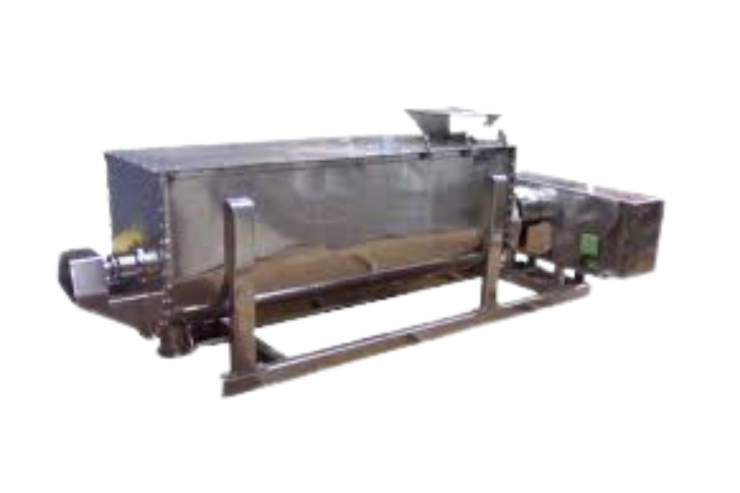
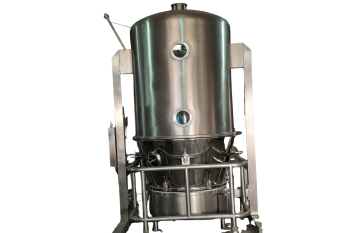
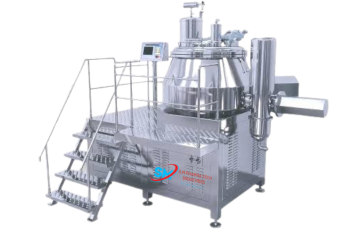
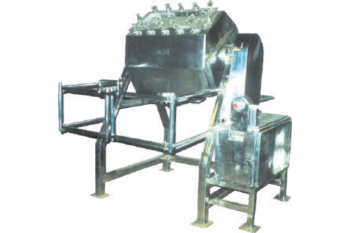
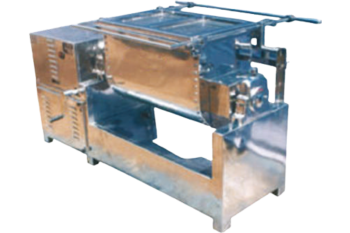
A ribbon blender (or ribbon mixer) is a horizontal mixing machine with a U-shaped trough and one or more helical ribbon blades mounted on a central shaft. These ribbons move materials in opposite directions to ensure thorough and uniform blending of powders, granules, or mixtures of solids and small amounts of liquid.
📊 Typical Ribbon Blender Specifications
🛠️ General Design
Configuration: Horizontal U-shaped trough with double or triple helical ribbons on a central shaft.
Material of Construction: Usually stainless steel (SS304 / SS316) for contact parts; mild steel for non-contact parts.
Agitator Drive: Gearmotor (compact reducer) or direct drive, variable speed options often available.
Discharge: Bottom center discharge valve (manual or pneumatic butterfly) / full tilting.
📦 Capacity & Size
Ribbon blenders come in many sizes — from small lab units to large industrial models:
Small / Lab Units: 10–50 L capacity with 0.5–1 HP motors.
Medium Industrial Units: 150–1000 L with 2–10 HP motors.
Large Heavy-Duty Units: 2000 L+ or up to 12,000 L (industrial scale) with 10–60+ HP motors.
Example typical ranges:
Parameter
Typical Range
Gross Volume
~150 L – 10,000 L+
Working Volume
~100 L – 6500 L
RPM
15–50 rpm (varies by design)
Motor Power
0.5 HP – 75 HP
⚙️ Performance Notes
Suitable for dry powder mixing, granules, and light liquid addition.
Batch should be ~70–80% of total volume for best mixing efficiency.
High mixing uniformity due to counter-directional ribbons.
🏭 Typical Uses
Powder blending in pharma, chemicals, food, spices, detergents, cosmetics and more.